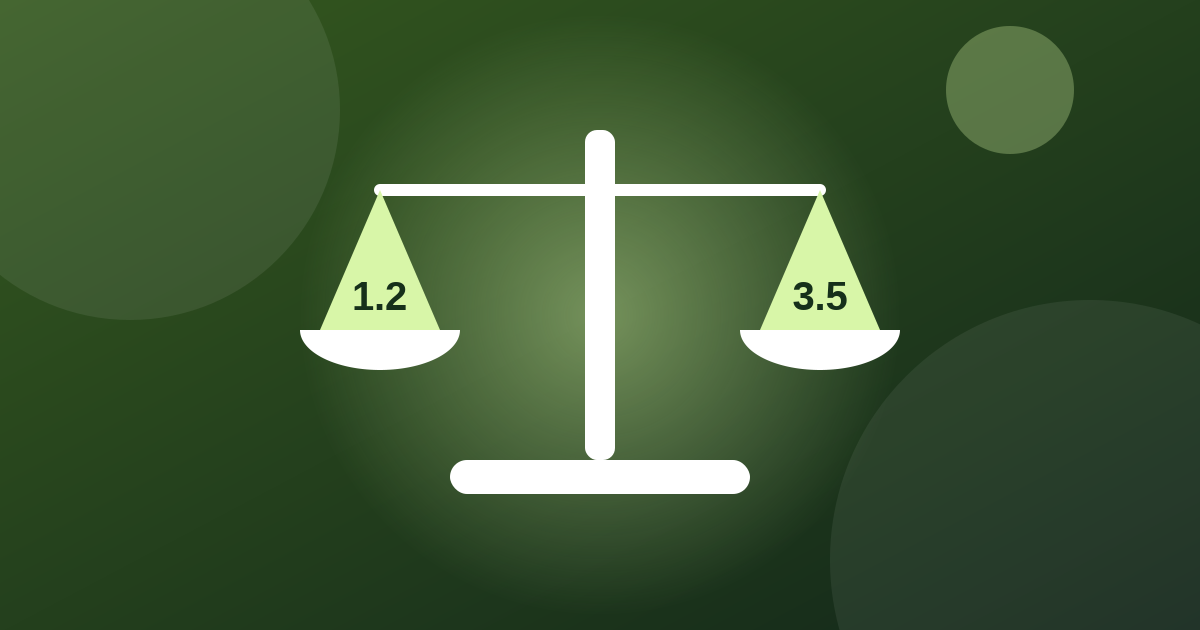
Every player perceives a bookmaker's line for a particular match in their own way. Some, seeing the potential winning amount on the coupon, like to bet on high odds, trying to cash in big. Others approach it too carefully and deliberately, trying to bet on what at first glance are the "most certain" (or, as they are commonly called, rock-solid) events, which are reflected in small odds. This category of players tries to increase profit "drop by drop", seeking the desired result by choosing a "tortoise" style - slowly, and, as it seems to the player, seemingly correctly.
Where do these two types of players end up? Let us figure it out.
1) Well, with the first type of players I think everything is perfectly clear. In big odds the bookmaker reflects a small probability. And where there is a small probability there are, as a rule, big losing streaks - the player's psychology usually breaks and the bankroll melts. All this is multiplied by the unsystematic nature of play on high odds and leads to sad results. Take, for example: the probability of an event with odds of 10, taking the bookmaker's margin into account, is less than 10%. That is, over the long run, roughly every 10th match will win. Given this fact and that bets are probabilistic in nature, "catching" exactly that match over the long run is very, very hard; moreover, if you consider all the games (without exception) that fall under the required scenario, the match itself may be played at an inconvenient time for you, when you cannot place a bet. Besides, working by such a system requires "splitting" the bankroll heavily and choosing the stake size so as to withstand big and unpleasant losing streaks during play. Incidentally, it immediately follows from this that the bankroll itself must be big, because playing for pennies makes very little sense, except perhaps for tests.
2) The second type of players perfectly realizes why the first type loses, and tries to play differently - betting on small odds slightly above one. But nevertheless this brings no results either: the bankroll at first seems to grow a little, and then quickly melts because of a couple of failures. Why? Let us figure it out. The thing is that low odds (from 1.01 to 1.35) are odds with a big economic disadvantage over the long run and a low ROI over the long run. Even without knowing what ROI means (a whole separate article is devoted to this term), it is easy to guess intuitively that it is better to place 2 bets at odds of 2.05 (let one of them win in the end and the other lose) than 4 bets at odds of 1.35 (three of which win and one loses). So what is better about it? The answer is simple — time costs and larger investments. Where a lot of bets are placed, the difference is strongly felt between having placed 1000 bets as opposed to 2000 bets. Besides, placing 2000 bets at exactly the odds you need is much harder than 1000, given the dynamics of odds changes in the line (that is, you simply may not be able to take all the offers). Low odds are attractive to play, but you will not build a long and stable profitable game with them.
The conclusion is this: on low odds you earn nothing, because the bets are too much like "interest in a bank" with a tangible risk, and on high ones you run into drawdowns and into the fact that it is impossible to discern a reliable edge over a short stretch. So some "golden mean" suggests itself here.
Many experienced players aim for a "golden mean" roughly in the range from 1.7 to 2.5. This is not a rigid rule but a guideline, at which the ROI can be decent, the number of bets sufficient to evaluate a strategy, and losing streaks do not hit the psyche so hard. But again, you need to understand that in general there are no strict rules of "right" and "wrong" ranges to play - after all, the main thing is that your strategy gives a plus precisely in the range of odds where you play.